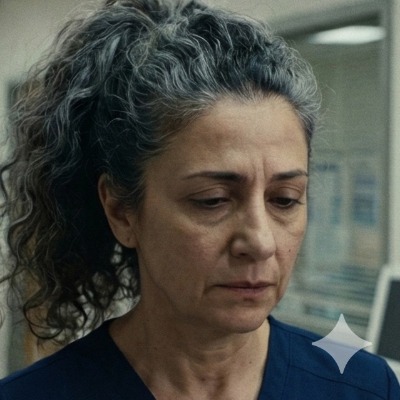
....It feels like putting on glasses she hadn't realized she needed. The feeling is sharp and specific enough that Dr Abazi half-starts to make a wry mental note about how she's really overdue to get her eyes checked, and then she stops and catches it and pins the thought down to dissect, because in fact it's not literally-that, just metaphorically the same sort of clarity -
- and that, the catching-and-pinning, that's not her baseline either. That's enhanced self-monitoring. Fascinating. She's watching her own cognition in real-time with a precision she doesn't usually have outside of deliberate meditation exercises, and even then it's effortful in a way that this - isn't.
Fascinating. She'll poke at it for a moment, run a quick internal inventory, the way she might assess a patient:
Her selective attention is... significantly sharper. The fluorescent-lights hum she'd been filtering out is still filtered out, but now she's - aware that she's filtering it, can actually feel the process of her brain deciding what's salient and what isn't. The signal-to-noise ratio on her own thoughts has improved dramatically.
Working memory. She pulls up the consult note she'd skimmed in the car—the three clusters, the bizarre labs, the phrase "experimental cellular therapy"—and it's all just there, organized, accessible, not the usual tired-end-of-day sludge of half-remembered details. This is the big one. She can almost feel her prefrontal cortex picking itself up and doing its job properly, which is surprising when she doesn't actually feel any less tired – physically it still feels like 8 pm after a long day, but it's decoupled from her thinking.
The most obvious way to assess the effect on her judgement is, of course, to think about where she's just been asked to exercise it: with this patient. What does she know? The absurd initial blood gas. The cardiac arrest, thirty minutes, asystole. The CT findings that the radiologist had called "remarkably benign." The bizarre consult note's "experimental cellular therapy" which is apparently not even "faith healing" like she'd been thinking of it before, but either absurd alien sci-fi technology or literal fucking magic of some kind. The three cognitive clusters described in terms that don't map to any assessment framework she knows. She can feel out the shape of what's still missing, a surprisingly precise awareness of which specific questions she needs answered before she can form a reliable clinical impression.
Emotional regulation. Ohhhh, and is that one interesting to poke. She's still pretty darned annoyed with Harrison, the overbearing arsehole, all smug and cryptic and presumptuous, taking for granted that she'd just drop everything for his agenda. But it's - contained, now, she can localize it in the tight knot behind her breastbone and not let it flavor all of her thoughts. Experiencing the emotion without being the emotion, the way those mindfulness meditation soundtracks always promise and never quite deliver.
And she can admit, without any particular defensiveness, that Harrison's excitement wasn't showmanship. Clearly, and for obvious reasons, he genuinely believes he's onto something significant. The nurse looks exhausted and is holding it together anyway. There's a patient in that bed who nearly died today and might still, and whether Dr. Abazi is pissy about her evening being disrupted is not actually relevant to wheth bShe was already planning on that, of course. She's a professional. She doesn't let irritation with colleagues get between her and a patient, even when they're being very obnoxious. But it's different to feel that knowledge settle into place without any effort of will at all.
Impulse control. That one she has to dig for, because it's always been a strength; it's basically a job requirement. But...the thing is that normally, cutting off the desire to snipe at Dr Harrison when she enters the room, and keeping the professional face on as long as she's in front of a patient, would be a choice she makes, a small expenditure of willpower, the brief internal process of composing the sarcastic response and then not saying it. Now there's just... nothing to inhibit. The sarcastic response doesn't arise in the first place, because she can see clearly that it wouldn't be useful, and her brain apparently decided not to bother generating it.

 This post has the following content warnings:

 View Flat HTML
 View Metadata
 Search Post