Accept our Terms of Service
Our Terms of Service have recently changed! Please read and agree to the Terms of Service and the Privacy Policy
« Previous Post
Permalink

If the boy had really loved her, he could have refused. 

It would have been kinder. 

But Voltur grows old, now, and he knows what lurks behind pretty words, most of the time. What the boy really wanted was to impress; what he really mourns, now, and begs the archbishop to save, is the dream he had, that he could be important, be feared, be loved. 

The girl says she did not know what it was she did, and he even believes her. But he knows she is not as sorry as she should be. 

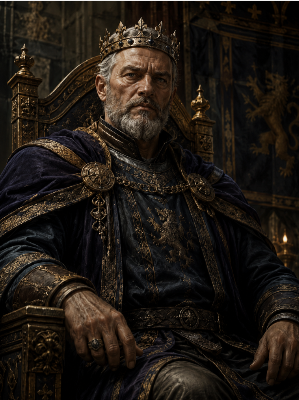
The Countess had not been pretty or graceful, like the old gods said a woman should be. She had not been fond of superstition. Voltur had known the woman's wife, a long time ago, when that was still a dangerous affair even in the heartlands - they'd tried to burn down that little village church where they had the wedding. She'd been a soldier, blunt and crude but one of a very small number of people you might think you could trust. Perhaps she had offended the old gods. Voltur certainly hopes she did. 

Ophel did not actually see the thing the Druids made of her. Voltur won't tell him, his queen doesn't need any more nightmares. 

There is a spell by which a man may be slain with but a word, on the instant; the old Queen had decreed it the only means by which a noble may die, as a mercy. Coincidentally, she was the only wizard in all the kingdom who could cast it. He, alas, has had to resort to other methods. But perhaps there was wisdom in what she did, so it is his sword now that spills noble blood. 

It was the smell he noticed first, when his thanes broke down the hill-fort and the cleansing wizard-fire burned back the twisted trees and ravening direwolves and good cold iron put down the archdruid. The things that had been the Countess, and her children - teeth ripped out, and fingernails (the old gods despised man for his weakness, they said, fangs and claws gone soft in the cities) - something blasphemous wrought upon their very skin (it was a sin to wrap oneself in cloth, they said, first sin of the first man) - something carved out of them, or into them, and now there was no recognition in those cataracted eyes, no prayers on those flayed lips even after his high priests healed their slit and ruined tongues, and no resistance when Blackthorn took their heads. 

Wizards are burned at death. He suspects he knows why. And so he ordered the same for them, and watched. Holes in their skulls, and strange patterns on the bones. 

She says she didn't know. She probably didn't. 

Ophel will listen and Ophel will cry and Ophel would want the both of them spared. He was a terribly foolish boy, you see, he didn't know why the Church was so strict about traffic with demons. And she only wanted to please her family, you see, it was how she was raised. 

He doesn't even have the heart to argue. 

The executioner's axe will be swifter and softer than the druids ascendant would be. Even now, he does those two children one last kindness.
Total: 106
Posts Per Page:
Permalink

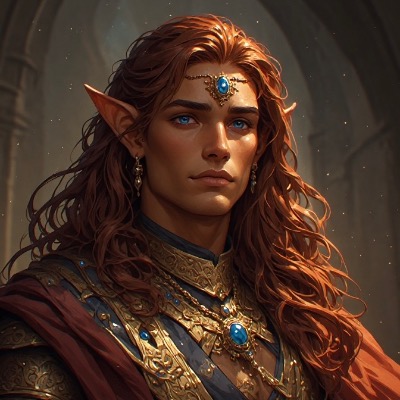
It has been a long time since last Ophel kneeled before his husband. He has been away for too long; away in the land of divine things, his absences growing longer and longer. Voltur changes every time – every time a colder man takes his place.

Nothing else will work.

Now he kneels again at the foot of the throne, clasping the king’s hand betwixt his own and bewitching him with eyes that do not belong to the world of men. He kneels again – not for his husband, but for the sake of another man.

“If you had heard how he sang tonight, you would pity the poor boy.” And indeed the pity saturates the queen’s voice like a bee drowned in honey. “You should have heard it. All of his sorrow won’t fit in his chest, it– burns like a fire, his heart is like a bird on a spit.”

Ophel’s breath shakes, and the boughs of trees shake with him.

“Voltur, my light – I entreat you—”

Permalink

"- To spare them. Yes."

He shifts on his throne. 

"You presume much. Stand up, Ophel, this drama is long since meaningless for us."

He can't stand to see those too-blue eyes any more, and so he looks away, down at the dais that his throne rests upon, up at the indigo evening sky that glows in his windows. 

"You presume I am lacking pity; you presume I am too cold, too distant. You are wrong as you often are. Pity moves me to vengeance, Ophel, it is only cold wisdom that stays my hand, for there are far harsher fates than Blackthorn for traitors even in your own kind's past. How long would you have them spend screaming, if passion is to move me? How long before I find you here again, begging for a swift end to their agonies?"

He sees as soon as he says it that it was the wrong thing to say. The wrong thing, for all that it's true, for all that he's only just finished gently turning away the friends and beloved of Lady Saralynn who bay by the dozens for blood and worse. He strikes out again, desperately. 

"Or ransom them, then, for the archdiocese. Take them on, bind them in magic chains, let them serve together rather than die. Only-"

He knows it's not going to work. 

"Ophel - you know I go among the people sometimes. There is a man, five and seventy - his kin are dead, all save his granddaughter and son-in-law - and your priests may preach against it but we have not the men to outlaw the beating of children, and even if we could - he drinks too much, and has the old man's money for it, and keeps the girl away, the only joy the old man has left in life, and blames him for it, when he has nothing left to give - it is not even among the worst horrors, only the most recent one to pass before my own eyes. Spend gold hand over fist, bid magic itself be spent, the cost of guard enough to make it safe to grant the rebels asylum, if you will - only answer me why they deserve your dear and precious and finite mercies, and not anyone else."

He knows it's not going to work. 

Permalink

“They all do.”

He does not rise. He clasps the mortal’s hand more firmly, and Voltur could tear his hand away if he truly wanted to, but that would risk breaking the softness of the elf’s rare touch.

“They all deserve our mercy. You are lost in abstracts, you have stopped seeing people as people. There is no justification for taking life when you have a choice– Voltur, husband, look at me.”

No divine command is etched by magic into his voice. It remains a force of willpower to resist. 

“Do you not remember when we first visited their town, when it was but a barbarian settlement? Do you not remember how the people there turned to the light, forgot all about their old ways and their cruelty, and we did not even need raise a single blade against them? We all search desperately for light.”

Ophel presses his lips in supplicating kisses to Voltur’s rings.

“My love – they are young, there is room to learn, to earn their respect, to show them what we are – he loves her. They have promised to run away together if need be – imagine the girl, she is not so much older than our own daughter. Imagine if it were–”

Permalink

He lets him kiss.

"No. I do not care to imagine it. For it would *not* be her-"


 tilting, sickening, he'd thought it wouldn't be his men either -


"- and if it were I would not withhold justice." He grits his teeth. "If you insist on tormenting me - if, all the gods forbid, it were her -"

(wrenching disorientation)

"- I cannot pretend I would not spare her, and send her for a slave for the Church for ever, rather than slay her as justice would demand. But nor will I pretend that would not be an indulgence, just as I buy her pretty dresses and bright jewels - I do not pretend that I would be doing good. And nor are you. Your coffers only have so much gold, you only have so much magic, and if you spend it here on the traitors then you cannot spend it elsewhere, where it might do more good, and for more deserving folk. I will not stop you indulging yourself to save them, Ophel, if your heart is moved, but I will not pretend it is any nobler than buying rare silks for yourself, instead of food for the poor." 

(The poor in Valynrest do not really starve any more, thanks to his efforts that the rebels would destroy in service of their own sick pride, but he doesn't labour the point.)

Permalink

(She is gone, and She cannot hear.)

Permalink

"What will it be then, my Queen?"

Permalink

The kisses have stopped. 

Ophel’s face clouds in shadow.

“I do what I can, when I can. My attention cannot be everywhere, but I cannot force my attention over cruelty when I see it, be it a stranger or my– own husband,” his voice nearly breaks, “as perpetrator. I fear for your soul, Voltur. I truly do. I did not name you king so that you might become a tyrant.” He delivers the next words quietly. “And I did not return to you your heart so that you might lose it again.”

He looks up at his husband, and his eyes are no longer so round and his tone is no longer so passionate, and the shutters are closing again. 

“I accept that they are not innocent, but the girl does not deserve death for what she did. She means nothing to you, but everything to the boy.” And the elf’s pain speaks for him. “He has the kind of love for her that– you and I once had. He cares not for the logic of kings, or the laws of your kingdom.”

Your kingdom.

“It is only for love that he sings.”

Permalink

"You do what you can, when you want to. The Druidists you weep for will be the first victims, the solemn fools, if we give their would-be masters quarter. You think of the love you and I have? What do you think it is, to have that sort of love, under Druidic rule? Would you like me to tell you, my Queen, what happens to men who lie with other men, under the Druids? Perhaps in some other time, your mercies and passions are aroused for them; you happen by chance to have met them and heard their cries instead; and some other Voltur's cold reason restrains your passions from vengeance."

He sighs, and seems to become smaller. 

"I cannot even say you are wrong. Elves are sweeter and gentler than my kind. Better it might have been, had your people lasted triumphant to rule over mine in kindly mastery. But those days have gone and shall not return. You may well detest the laws of kings, but they are all that shelter you. And indeed all that shelter them from what would rightly befall them, at the hands of their victims' kin. You did not answer that charge, I note. Shall I then withdraw the kingdom's justice from them, Ophel? Shall I stay my hand and sheathe my sword? Would you prefer my mercy, over my justice?"

Permalink

Permalink

“It was not so long ago that I vowed to honour your law, husband. But it is the Law that protects us.”

Ophel’s mouth forms a tight line, holding fast through the agonies that would have sickened any other of his kin. The exhaustion dulls his heart.

His people journey through the years slowly. Perhaps Voltur cannot fathom it truly, much though the man seems to consider himself knowledgeable on elven matters. Humans move so fast through their brief lives that they rarely try to understand the meaning of it, of the meaning of anything at all – slowly.

For better and for worse, it is the lot of elvenkind to bear witness.

Long ago, in the days of the war between their peoples and some decades after that, human kings would covet elven brides – the history-singers say either by force or by arrangement. Love was of little consequence. Such unions promised men a watcher that would ensure the survival of generations of their line, bound to children who would soon never know them, until the tombstones of their mortal husbands had worn down smooth. Their stories are black marks on elven history. Oftentimes they died from grief, or of relief when the last of their line fell at last and they could at last be free.

Ophel had told himself that this was different. He was not one of them. 

To him, the memory of Voltur’s tears of joy at their wedding remains as clear as the rain that had fallen upon the land this morning. The black hair on his lovely head lost its colour almost as quickly as the leaves turn in autumn, and his soft eyes soon saw only enemies abound, and Ophel looks at him now sometimes in confusion, without real recognition, searching for the face of the common king that only he remembers truly. 

He is older now than Voltur when they had first met. 

“Mercy and justice are not different things.”

Permalink

Thus says the Prophet: Why do you bow to a law written by hands that return to the dust? A king’s command is but a passing whisper, but the Law of the Lord is a consuming fire that tries the works of all flesh.

Permalink

"The Law isn't here. Only me." He says it in what to Ophel's eyes can only be true, deep, bitter disappointment. 

He looks up. "And whatever the Law may be, in the canons of the Church the penalty for diabolism is burning alive."

Permalink

(It's not cruelty. Some demons can possess people and lie dormant inside them, sometimes for years. You need something that will also kill the demon spirit when it bursts out.)

Permalink

He sighs. "It is not yet beyond me to see myself through your eyes. Come then, Ophel. What would your judgement be? In truth I doubt your wisdom, but I see the way this is on course to go. I have no wish to become a cautionary tale in your histories for future kings."

Permalink

“Where there is remorse, where there is love, there is hope. You will do yourself no favours by hardening the hearts of your enemies. The more druid children there are who doubt the ways of their ancestors, just as the boy and the girl have expressed tonight, the stronger your position, my king. It would be unwise to weed out remorse in those you claim you wish to save. We could use this chance to educate them; to use them, even, for what they know of their own people. We have such little understanding of the ways of their tribes, we could use them to find weaknesses in their side – or perhaps even common ground.”

He laces their fingers together; rests his heavy head on his husband’s lap, and prays he will be permitted to stay there. He prays he will get through to him.

“Unless your motivations have changed, that is. Humans were not supposed to carry the kind of burden that you do, my love. It is all too easy for your kind to lose sight of Good. I wish I had not put you upon this throne; I fear so terribly for your soul. You were never the sort of man who could see justice in what you claim you must do. If you raise your blade against the girl tomorrow, Voltur, for as long as she regrets what she did and strives to learn better, then in the eyes of Pelor it will be–

Murder.

You will seal the fate of this war as one you must win by bloodshed alone.

You will never save any of them. You will have conquered lands empty but for the corpses of the people who had once lived there.

The Law is always here. My mistake was to shield you from it.

I will not bear witness to it.

I have passed judgement. The girl does not deserve to die. But you will not listen to me, for all you once trusted me even as we both looked together into the maw of the usurper dragon.”

Permalink

"You are wrong. Wrong, in so very many ways. Remorse is not enough, not at the scale of what she did; even if she is sincere, she is too dangerous to leave alive, too great a threat to my people. She is an oathbreaker as well as a murderess, she has done enough to condemn her five times over, enough to make it too great a risk, too great a cost, to save her life. If you will only ever take action against the truly base and unrepentant, you will fail, at others' cost. You will make countless innocents pay the price of your mercy, Ophel, because this has nothing to do with justice, it is about you and your feelings."

In truth, he's surprised the Dawnfather hasn't withdrawn His grace already. He's pretty sure that what Ophel is saying is technically blasphemy. There's a reason He almost never Chooses elves.

He sighs, and sinks back in his throne. 

"Or so it seems to a tired old man who once thought to bring a wicked land to God. You are wrong there too, Ophel. I will still listen to you, even now; I trust you as I have trusted no other. Do as you will with her."


Permalink

His eyes close, and some sculptor’s hands carve lines deep into his face. The victory is hollow.

He is tired.

Permalink

“When did we become this?”

Permalink

"When your poetry, and your pride, and my dreams, came into contact with reality."


He stands, and whirls, and departs from the throne room.


Permalink

The girl's remorse is true, it seems, or else she is very very careful to make it seem so. She serves diligently, as does the boy who loves her. In time they take new names and new lives elsewhere; in time they marry, in church, before the sight of Heaven and before properly ordained priests, and there is no further danger from them. 

The next few times a criminal rises to the King's personal attention, and the Queen intervenes crying mercy, he relents and they are spared and no further harm comes from them either.

It comes to be known, then, that a case which reaches the Queen's ears will be handled with uncommon mercy and sweetness.

It comes to be widely known. 

Godwin is a quiet man, a guardsman. Not very much can be said about him. He hears stories of the past, stories of the King's war on men from across the Sea of Tears who know the names of the true gods, whose vengeance on the unbelievers will be terrible, cloaks of burning fire and drownings in lakes of brimstone; he hears of how the King dares to rebel against the believers of the true path. 

So he goes and joins with the followers of the true gods in the capital and finds his way to the palace, and he is caught there, and pleads mercy, swearing in the name of his gods and his fathers, for it is permissible to deceive the unbelievers in desperate circumstances, to save one's own life from their cruelties. 


He is believed and released into service, in an Aphrodisian temple as it happens, and there is where he can really get to work. 

Permalink

The Church keeps its slaves in shackles of course, but if their souls are the right shape, it still gives Him great insight into the enemy's inner workings. And no bonds are perfectly tight. There is always a cost, you see, and some opportunity even for Him. 

Permalink

When it ends, when it all ends, the Archcurate of Aphrodite in Valynrest, a small slender elf of tender years by that people's standard, is dead and worse, as are the family, dead of grief, and a number of the other faithful, and dozens more - specifically, the attendants of a special mass on the true nature of love, written for those born under the Druids, who might have been led astray, as Ophel ordered. It was corrupting the sons of the Old Fathers, you see. 


And it's known what will happen if word of this reaches the king, so while the Kingsguard are distracted in the ashes of the Temple, putting down the monster he summoned, the mob take him away. 

Permalink

She knows what's going to happen. She swore to Voltur as her king, he takes her counsel, but she cannot in fact countermand him. 

Is it a betrayal, not to stop this? No. She would, all else equal, no matter the cost; but the demon must be stopped first, the dying must be shriven and comforted, the wounded must be healed. She considers killing Godwin in one swift blow before the mob can reach him, but that might be called Murder, and she cannot actually spare a moment away from the battle with the fiend of the pit. 

Permalink

Good! So they take Godwin from that place and lash him to a cartwheel and break his long bones with hammers, to general rejoicing. 


The gods won't allow Healing to be used for this, but there are ways to keep a man alive for a while anyway. 

Permalink

The sound of a charging horse is all anyone hears first.

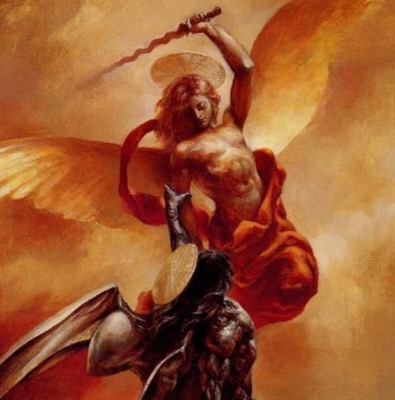
Then the earth begins to rumble, and the Sun glares ever-brighter, and the voices of angels join the chant of a terrible Miracle.

Wings sprout from the archbishop’s back, tearing his flesh apart, and the blood sinks red into the ashes of the temple – and he rises.

The cells of the world around him join the chant. Ears bleed, windows crack. The people run and take cover.

There is a flare like blinding lightning all around the sky. Hands burst forth from fissures in the sky, and a hundred seraphim force their way through into this world.

And like a swarm of bees, they all fly to the demon.  

It is a mercy-killing when Baptist strikes the final blow.

A Mass Heal takes care of those who survived. The guardsman’s bones stitch together in the wrong places, crunching agonisingly. The seraphim form a ring like columns around him as he howls, their protection inviolate.


Afterwards, a winged Apollyon kneels silent in the broken heart of the rubble.

Total: 106
Posts Per Page: